




“If these chairs could talk…”
The monobloc chair is probably the most popular piece of furniture in the world, as well as being one of the most functional thanks to its lightness, durability, and affordable price. Companies such as Pedrali, Nardi, Baxter, Magis, and EMU have reinterpreted its shape in a wide range of models and colors, capable of meeting a wide variety of aesthetic and functional needs.
On our Forma Design website, we’ve selected a few models of monobloc chairs—from the countless alternatives available—selected for quality, style, and design value from the catalogs of top design companies.
Over the years, the monobloc chair line has evolved to adapt to contemporary tastes, thanks to increasingly innovative materials and sustainable production processes, without however losing sight of its origins.
Contemporary interpretations of the monobloc chair
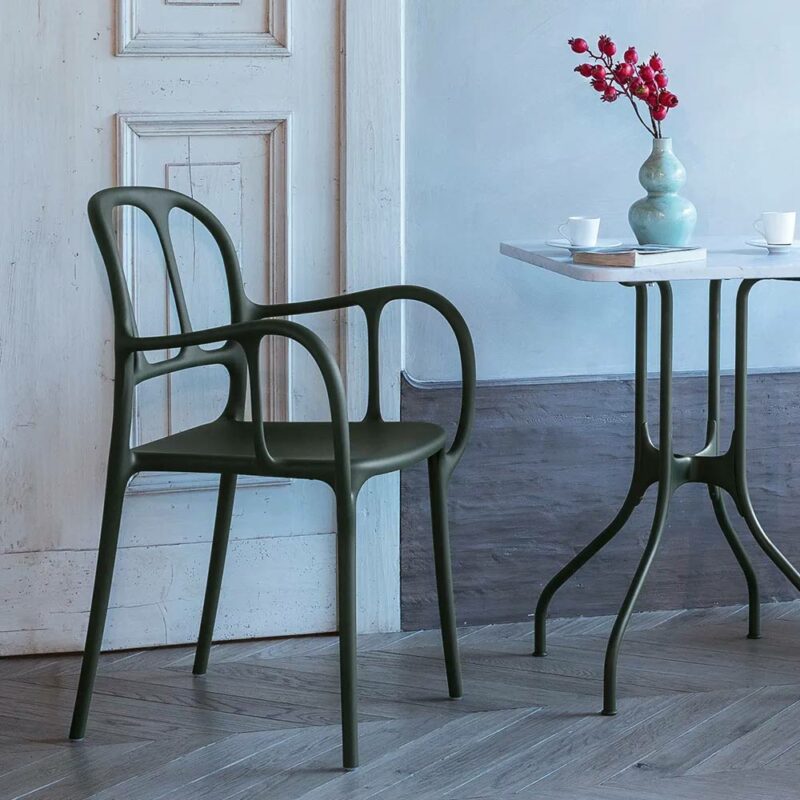
A prime example is the refined Milà by Magis, a chair with a light and airy line that recalls the free and irrational imagination of Art Nouveau, evoking the works of the Catalan master Antoni Gaudí.
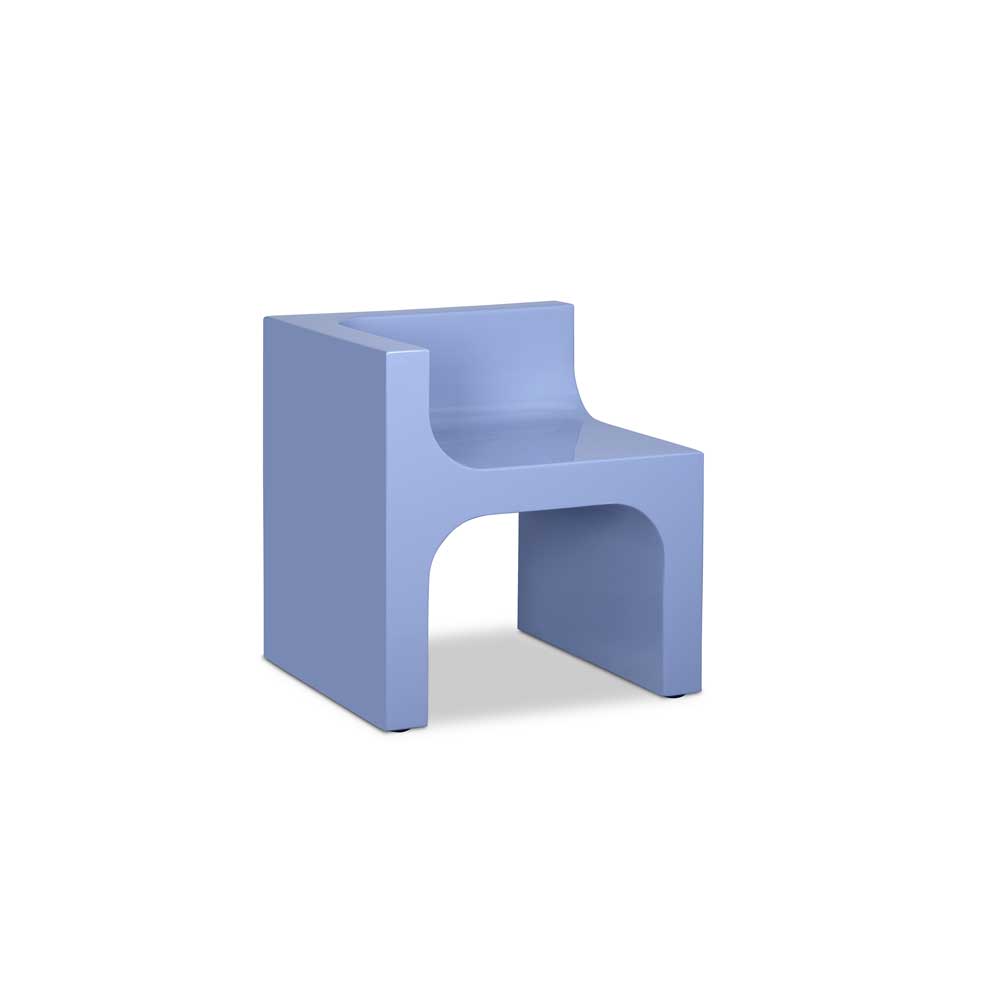
In stark contrast, we find the Dharma armchair from Baxter’s new outdoor collection: a seat with a compact, solid, and minimalist structure. Dharma was born from a vision that looks to the past but decisively traces the lines of the future.
Pedrali’s Volt 670, also available with armrests, sits midway between these two extremes. Its design is characterized by elegant and ergonomic proportions, making it lightweight and comfortable. This monobloc chair strikes a perfect balance: it respects the structural lines of its historic predecessor, while updating its details with a contemporary twist.
And the monobloc chair, for better or worse, continues to be the talk of the town.
Curiosities about the monobloc chair
At the Vitra Campus in Weil am Rhein, an exhibition was dedicated to the history and evolution of the monobloc plastic chair, a seemingly anonymous object that, through its popularity, has become a global icon. A constant presence in the most diverse settings: from childhood to urban settings, from private gardens to public spaces.
The monobloc chair is—allow me the comparison—like a work by Giorgio Morandi: a silent, poetic presence, capable of evoking memories and atmospheres without fanfare. It’s a democratic object that unites opposing environments: the most run-down spot along an ordinary road and the grandparents’ welcoming garden, the village café, or the courtyard of a hamlet.
We saw her at midday in front of the doorways, in the quiet streets of small towns, as a sign of anticipation for the evening, ready to welcome the chatter in the cooler hours of the day.
“If that chair could talk… it would talk gossip and poetry, in all dialects.” (Editor’s note)

A chair for the world
The white monobloc chair was the protagonist of the exhibition “Monobloc – A Chair for the World”, with 20 examples on display and a photographic section dedicated to its global diffusion.
Its history dates back to the 1920s, but it was in the 1950s that technology allowed for single-stage production. Among the first iconic models are the Panton Chair (1958–68) by Verner Panton, the Bofinger Chair (1964–68) by Helmut Bätzner, and the Selene (1961–68) by Vico Magistretti.
In 1972, French engineer Henri Massonnet revolutionized the production process with the Fauteuil 300, reducing the cycle to less than two minutes and making the monobloc chair a product truly accessible to everyone.
From the 1980s onwards, mass production favoured its global diffusion, while in recent decades conceptual reinterpretations have arrived such as the Café Chair by the Campana brothers (2006) or the Mono-throne by Martino Gamper (2017).
With Respect Cheap Furniture (2009), Martí Guixé launches a cultural provocation: 150 white and 30 green monobloc chairs become the vehicle for the message “Honour Cheap Furniture.” The furnishings then become a permanent fixture in the museum, used daily.
The monobloc chair has a rich and contradictory history: loved, hated, debated. In Basel, Switzerland, it was even banned because it was deemed harmful to the urban landscape.
“Some love her, some hate her… she’s almost a diva.”
As Oscar Wilde wrote in The Picture of Dorian Gray: “There is only one thing worse than being talked about, and that is not being talked about.”